
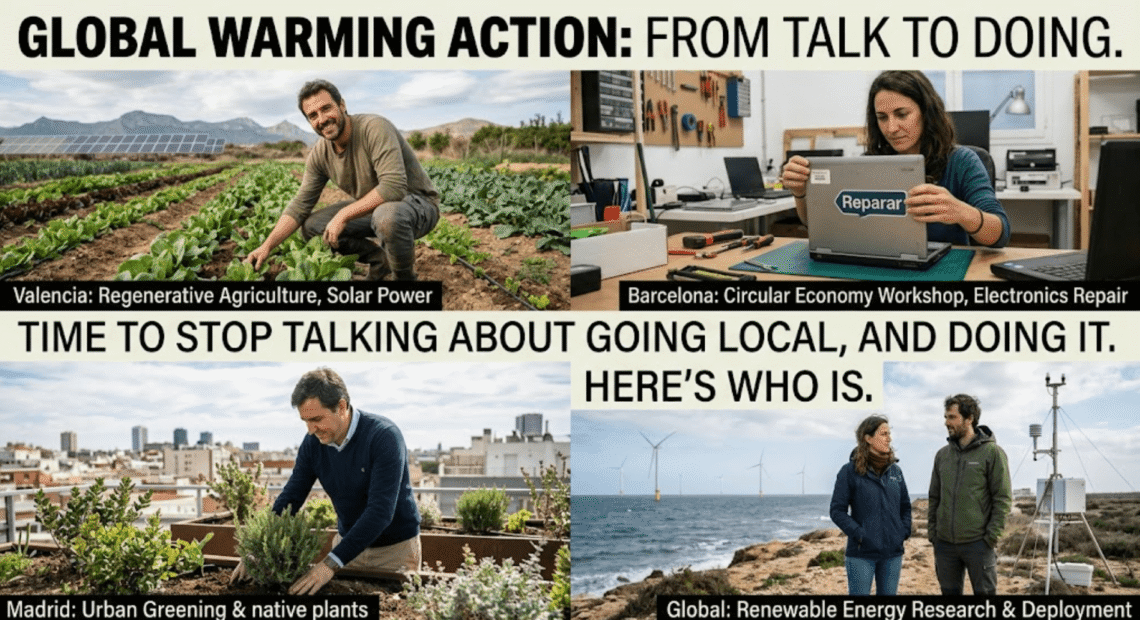
Time to Stop Talking About Going Local, and Doing It. Here’s Who Is.
We’re living in interesting times, and it’s anybody’s guess what the economy, the environment, our society will look, even in the next year. The COP15 UN climate change gathering currently happening in Copenhagen isn’t panning out as many would have wanted, and solutions to unifying the world’s goals look further off.
Wayne Maceyka has a single, clear, suggestion: Go local, in all aspects, (re)building robust, agile, stable societies and economies in the process. In part 2 of his 3 part series, he focuses on the organizations currently happening to help support that.
I mentioned Michael Shuman’s book Going Local in the first post of this series, and for those interested in exploring ways to localize their economies, it’s a good resource. Civic Economics, with staff in both Austin, TX and Chicago, IL is another organization providing innovative consulting services for local economic development efforts.
On Michael Shuman’s Small-mart website, there are additional resources available to local economy advocates and defenders. In the Small-mart blog, he announced the combination of Small-mart and The Business Alliance for local Living Economies “BALLE”. BALLE formed out of a fortuitous meeting between Laury Hammel and Judy Wicks, both board members of the Social Venture Network and has been focusing on helping build resilient local economies since 2001.
The organization has grown to include 75 community networks with over 20,000 entrepreneurs & members across the US & Canada. Look for “Sustainable Business Networks” in your area to connect with interesting and creative people working in the local economic development space.
Developing local currencies are a way to keep capital in communities and build stronger connections between people and businesses. Famous examples are Ithaca HOURs, from Ithaca, NY and BerkShares from Berkshire County in Western Massachusetts (forgive my Northeast focus; I am sure there are more successful examples out there, and I’d love to hear about them, below in the comments). The IthacaHOURs site offers resources for communities interested in developing local currencies of their own. It’s worth checking out.
Of recent interest in the conversation about alternative economic models is the rise of the “slowmoney” investment philosophy through the Slow Money Alliance; “patient capital” seeking to provide investors financial payback as well as social and environmental capital appreciation through agricultural investment. They seek to bring money back down to earth. The effort is something of an off-shoot (or maybe a continuation) of the thinking around Slowfood, seeking to reconnect eaters with their food sources. The key questions asked by the Slow Money Alliance, and ones that I feel generate some interesting ideas are:
- What would the world be like if we invested 50% of our assets within 50 miles of where we live?
- What if there was a new generation of companies that gave away 50% of their profits?
- What if there were 50% more organic matter in our soil 50 years from now?
The first Slow Money Conference occurred in Sante Fe, NM and received quite a bit of press, with articles in the LA Times, Wall Street Journal, TIME, and Business Week. Is there a market for “patient capital”?
Perhaps there are enough investors that have had enough with the speculation that seems to pass for “investing” now-a-days and will be content to fund a local food enterprise and reap the slow and steady reward of building multiple forms of capital. Are there enough of these investors to change our course?
A somewhat different take on the relocalization concept comes from the Transition Towns Initiative. My take is that this initiative has come to the conclusion that we’ll be facing a far different energy situation within the next 20 years (peak oil is mentioned overtly) and therefore will be forced to bring basic necessities for life “back home”. They’re seeking to bring people together and draw upon the existing community skills to redevelop capabilities to meet basic needs locally.
The New York Times Magazine had a lengthy article on the concept (coinciding with the financial crisis of course) entitled The End Is Near! (Yay!). I’m not sure the article’s title accurately reflects what many people think, though a recent rather scathing Worldchanging post echoed some of the NYTimes’ sentiments (I replied to that post); that the Transition Initiative has accepted a future of scarcity and proceed with an ideological rather than fact-based mission.
I’ll leave you to draw your own conclusions, and would be interested to hear your thoughts on this, and who else you see taking proactive action to effectively localize, below.
In the 3rd and final part of this series on localization, we’ll look at how food, transportation and infrastructure play a part in this equation.